Chapter 5 Modeling of Classification Processes (Screens and Hydrocyclones)
📘 Chapter 5
Modeling of Classification Processes
(Screens and Hydrocyclones)
5.1 Introduction to Classification
After comminution, mineral particles have a wide range of sizes. It is necessary to separate particles based on size so that fine particles can move forward for separation and coarse particles can be sent back for further grinding.
This process of separating particles according to size is known as classification.
Classification plays a critical role in controlling product size and improving the efficiency of mineral processing circuits.
5.2 Definition of Classification
Definition
Classification is the process of separating particles into different size fractions using a separating medium such as screens or fluids.
Classification does not break particles. It only separates them based on size or settling behavior.
5.3 Importance of Classification
Classification is necessary because:
It prevents over-grinding of fine particles
It reduces energy consumption
It improves separation efficiency
It controls the final product size
Without proper classification, mineral processing circuits become inefficient and uneconomical.
5.4 Types of Classification Equipment
The most commonly used classification equipment in mineral processing are:
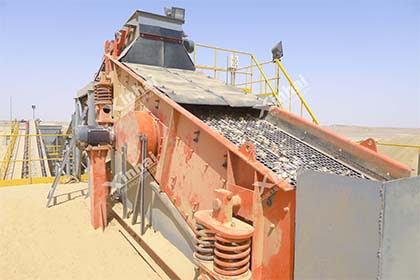
Screens
Hydrocyclones


5.5 Ideal and Actual Classification
Ideal Classification
All particles smaller than the cut size go to the fine stream
All particles larger than the cut size go to the coarse stream
Actual Classification
Some fine particles report to coarse stream
Some coarse particles report to fine stream
Thus, classification is never perfect.
5.6 Partition Curve
Definition
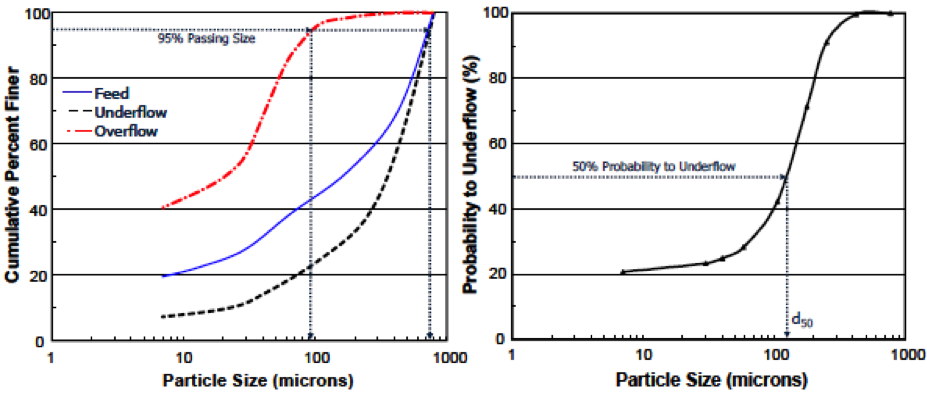
A partition curve shows the probability of particles of different sizes reporting to one of the product streams.
X-axis: particle size
Y-axis: fraction of particles reporting to coarse stream


5.7 Cut Size (d₅₀)
Definition
The cut size (d₅₀) is the particle size at which 50% of the particles report to the coarse stream and 50% report to the fine stream.
The cut size represents the dividing line between coarse and fine particles.
5.8 Sharpness of Classification
Definition
Sharpness of classification indicates how well a classifier separates particles by size.
Sharp curve → good separation
Flat curve → poor separation
A sharper partition curve indicates higher classification efficiency.
5.9 Classification Using Screens
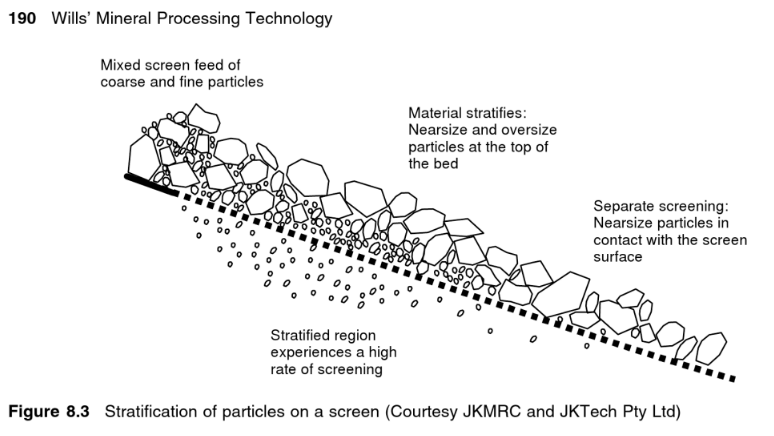
Screens separate particles based on physical size.
Working Principle
Particles smaller than the screen aperture pass through
Larger particles are retained on the screen surface

5.10 Screen Performance Modeling
Screen performance depends on:
Aperture size
Particle size
Screen vibration
Feed rate
Screen models estimate the probability of particle passage through the screen.
5.11 Classification Using Hydrocyclones
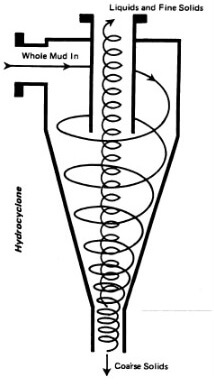
Hydrocyclones separate particles using centrifugal force generated by swirling slurry.
Working Principle
Coarse particles move outward and exit through underflow
Fine particles move inward and exit through overflow
5.12 Important Hydrocyclone Models
1. Lynch Model
Uses partition curve approach
Based on experimental observations
Widely used in simulation
2. Plitt Model
Predicts cut size (d₅₀)
Considers cyclone geometry and operating conditions
These models help predict cyclone performance without conducting plant trials.
5.13 Classification Efficiency
Definition
Classification efficiency measures how effectively particles are separated according to size.
Efficiency depends on:
Feed size distribution
Feed pressure
Pulp density
Cyclone dimensions
5.14 Role of Classification in Closed-Circuit Grinding
In closed-circuit grinding systems:
The mill reduces particle size
The classifier separates fine and coarse particles
Coarse particles are returned to the mill
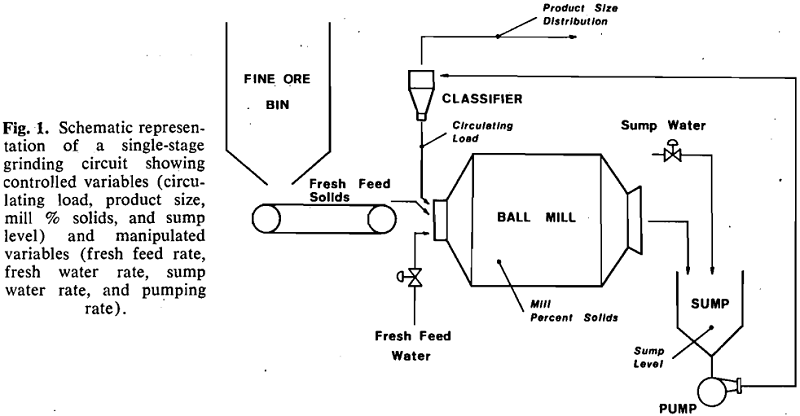
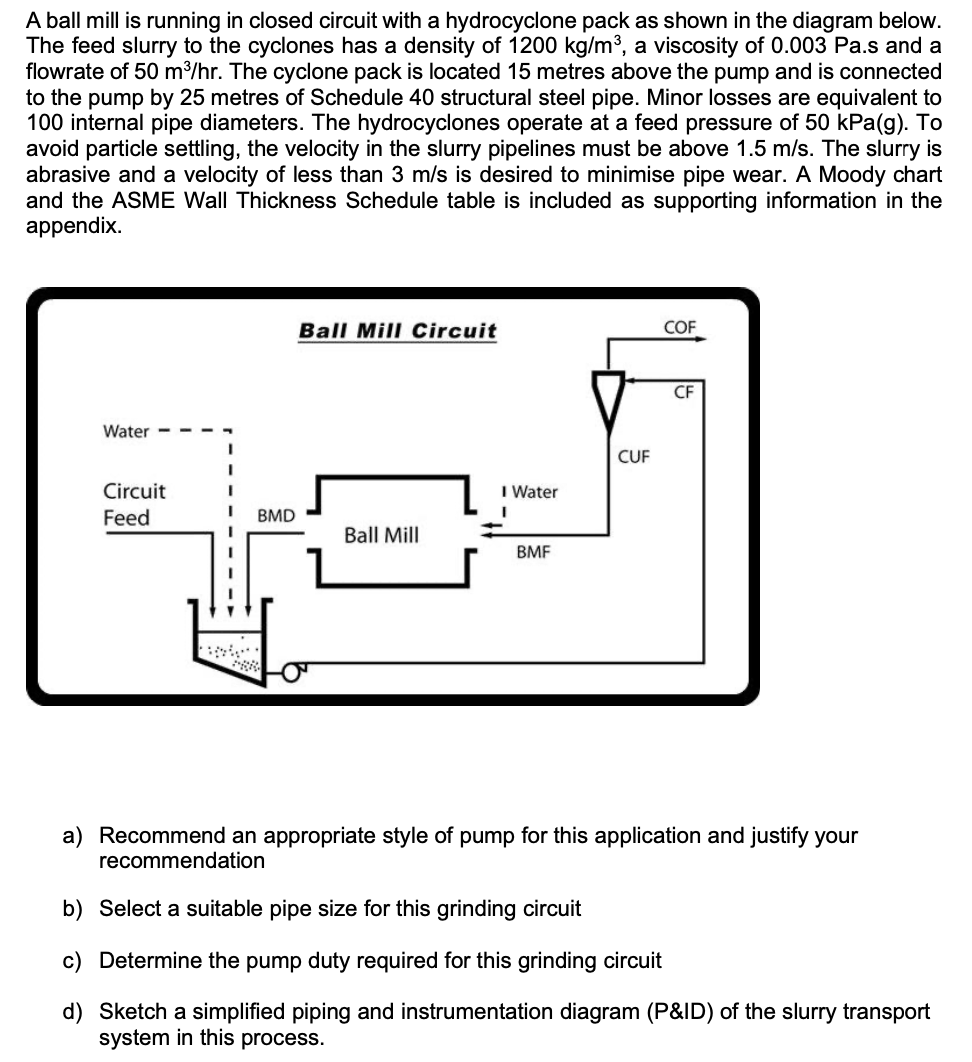
Classification controls the circulating load and final product size.
5.15 Classification in Simulation
In mineral processing simulation:
Feed PSD is given as input
Classification models apply partition logic
Output PSD is calculated for coarse and fine streams
Simulation software uses classification models to predict circuit behavior.
5.16 Summary
Classification separates particles based on size
Screens and hydrocyclones are common classifiers
Partition curve represents separation behavior
d₅₀ is the cut size
Sharpness indicates quality of separation
Classification is essential in closed-circuit grinding
5.17 Important Examination Questions
Define classification
Explain partition curve
Define cut size (d₅₀)
Explain sharpness of classification
Explain working of screens
Explain working of hydrocyclones
Explain the role of classification in grinding circuits


Comments
Post a Comment