Chapter 4 Modeling of Comminution Processes (Crushing and Grinding)
📘 Chapter 4
Modeling of Comminution Processes
(Crushing and Grinding)
4.1 Introduction to Comminution
Comminution is the first and most important step in mineral processing. The main purpose of comminution is to reduce the size of ore particles so that valuable minerals are liberated and can be separated in subsequent processes.
If particles are not reduced to the required size, separation processes such as flotation and gravity concentration become inefficient.
4.2 Definition of Comminution
Definition
Comminution is the process of reducing the size of solid particles by the application of mechanical forces.
Comminution includes:
Crushing – coarse size reduction
Grinding – fine size reduction
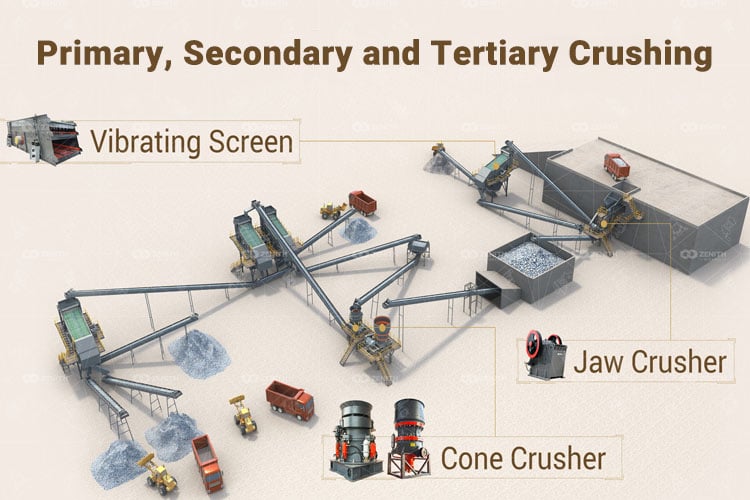

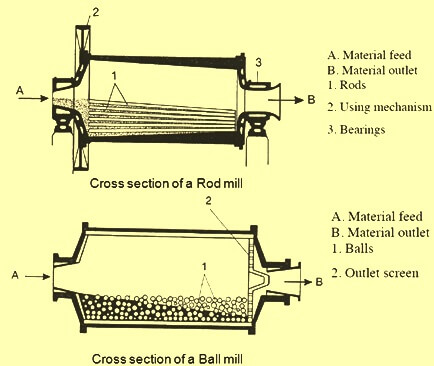
4.3 Objectives of Comminution
The main objectives of comminution are:
Liberation of valuable minerals
Reduction of particle size
Preparation of feed for separation processes
Improvement of recovery and efficiency
4.4 Why Comminution Needs Modeling
Comminution processes are complex because:
Large number of particles are involved
Breakage is random
Internal behavior of crushers and mills cannot be directly observed
Modeling helps to:
Predict product size distribution
Estimate energy consumption
Analyze effect of operating conditions
Design and optimize comminution circuits
4.5 Mechanisms of Particle Breakage
Particles break due to mechanical forces acting inside crushers and mills.
Main Breakage Mechanisms
1. Shatter
Sudden breakage due to impact
Produces many fragments
2. Attrition
Gradual wear due to rubbing and abrasion
Produces fine particles

4.6 Progeny Particles
Definition
Progeny particles are the smaller particles produced when a larger parent particle breaks.
Example:
A 20 mm particle breaks into particles of sizes 8 mm, 6 mm, 4 mm, and 2 mm.
All these fragments are called progeny particles.
4.7 Population Balance Approach in Comminution
In comminution:
Large particles break into smaller particles
Mass is transferred from coarse size classes to fine size classes
Population balance modeling is used to:
Track this transfer of mass
Predict changes in particle size distribution
4.8 Selection Function
Definition
The selection function represents the probability that particles of a given size will undergo breakage.
Important characteristics:
Depends on particle size
Larger particles usually have higher probability of breakage
Smaller particles have lower probability of breakage
4.9 Breakage Function
Definition
The breakage function describes how a particle breaks into smaller fragments.
It represents:
The size distribution of progeny particles
Fraction of mass entering each smaller size class
4.10 Difference Between Selection and Breakage Functions
| Selection Function | Breakage Function |
|---|---|
| Indicates how often particles break | Indicates how particles break |
| Depends on particle size | Depends on breakage mechanism |
| Related to breakage rate | Related to fragment distribution |
4.11 Energy Requirement for Comminution
Energy is required to break particles. Several energy laws are used to estimate energy consumption during size reduction.
4.12 Kick’s Law of Comminution
Statement
Kick’s law states that the energy required for size reduction is proportional to the logarithm of the size reduction ratio.
Equation

Kick’s law is suitable for coarse size reduction, such as crushing.
4.13 Solved Numerical Problem
Problem

Answer
Energy required = 4.85 kJ/kg
4.14 Closed-Circuit Grinding
In many mineral processing plants, grinding is carried out in a closed circuit.
Closed Circuit Definition
A closed-circuit grinding system consists of a mill and a classifier connected in a loop.
Coarse particles are returned to the mill
Fine particles leave the circuit as product
4.15 Advantages of Closed-Circuit Grinding
Better control of product size
Reduced over-grinding
Improved grinding efficiency
Lower energy consumption
4.16 Comminution Modeling in Simulation Software
In simulation software:
Mill models use selection and breakage functions
Classification models control recycle flow
Mass balance is solved for each size class
Simulation helps to predict product size distribution and circuit performance.
4.17 Summary
Comminution reduces particle size by crushing and grinding
Particle breakage occurs due to shatter and attrition
Progeny particles are formed after breakage
Selection and breakage functions are used in modeling
Kick’s law estimates energy for coarse size reduction
Closed-circuit grinding improves efficiency
4.18 Important Examination Questions
Define comminution
Explain shatter and attrition mechanisms
What are progeny particles?
Define selection function and breakage function
State and explain Kick’s law
Draw and explain a closed-circuit grinding system


Comments
Post a Comment