Chapter 3 Population Balance Modeling
📘 Chapter 3
Population Balance Modeling
3.1 Introduction
In mineral processing, unit operations such as crushers, mills, screens, and cyclones handle millions of particles at the same time. These particles differ in size and behave differently inside equipment.
It is not possible to track the behavior of each individual particle. Therefore, mineral processing models are based on the statistical behavior of particle populations rather than individual particles. This approach is known as Population Balance Modeling (PBM).
3.2 Particle Population
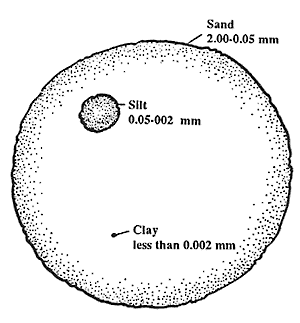
A particle population is a large collection of particles with different sizes present in a mineral processing stream.
Each particle population is described using:
Particle size distribution (PSD)
Mass or flow rate
Instead of analyzing single particles, the entire population is studied as a group.

3.3 Need for Population Balance Modeling
Tracking individual particles is not practical because:
The number of particles is extremely large
Particle breakage is random
Computational effort becomes excessive
To overcome this difficulty, particles are grouped into size classes, and the movement of mass between these size classes is tracked.
3.4 Size Classes
In population balance modeling, the entire size range is divided into discrete size classes.
Each size class contains particles within a specific size interval.
Example of Size Classes
| Size Class | Particle Size Range (mm) |
|---|---|
| 1 | > 10 |
| 2 | 10 – 5 |
| 3 | 5 – 2.5 |
| 4 | 2.5 – 1.25 |
| 5 | < 1.25 |
All particles within a size class are assumed to behave in a similar manner.


3.5 Concept of Population Balance Modeling
Definition
Population Balance Modeling (PBM) is a method used to describe how particle populations change due to physical processes such as breakage and separation.
PBM tracks:
Movement of mass between size classes
Generation of smaller particles
Removal of particles due to classification or separation
3.6 General Population Balance Equation (Conceptual)
For any size class, the population balance is expressed as:
Input − Output + Generation − Loss = Accumulation
Where:
Input: material entering the size class
Output: material leaving the size class
Generation: particles produced by breakage of larger particles
Loss: particles leaving the size class due to breakage or separation
Accumulation: change in mass within the size class
3.7 Steady-State Population Balance
In most mineral processing plants, steady-state operation is assumed.
Steady-State Condition
System variables do not change with time
Accumulation term is zero
Therefore, the population balance equation becomes:
Input + Generation = Output + Loss
This assumption simplifies calculations and is widely used in mineral processing simulators.
3.8 Population Balance in Comminution Processes
In comminution operations such as crushing and grinding:
Large particles break into smaller particles
Mass is transferred from coarse size classes to fine size classes
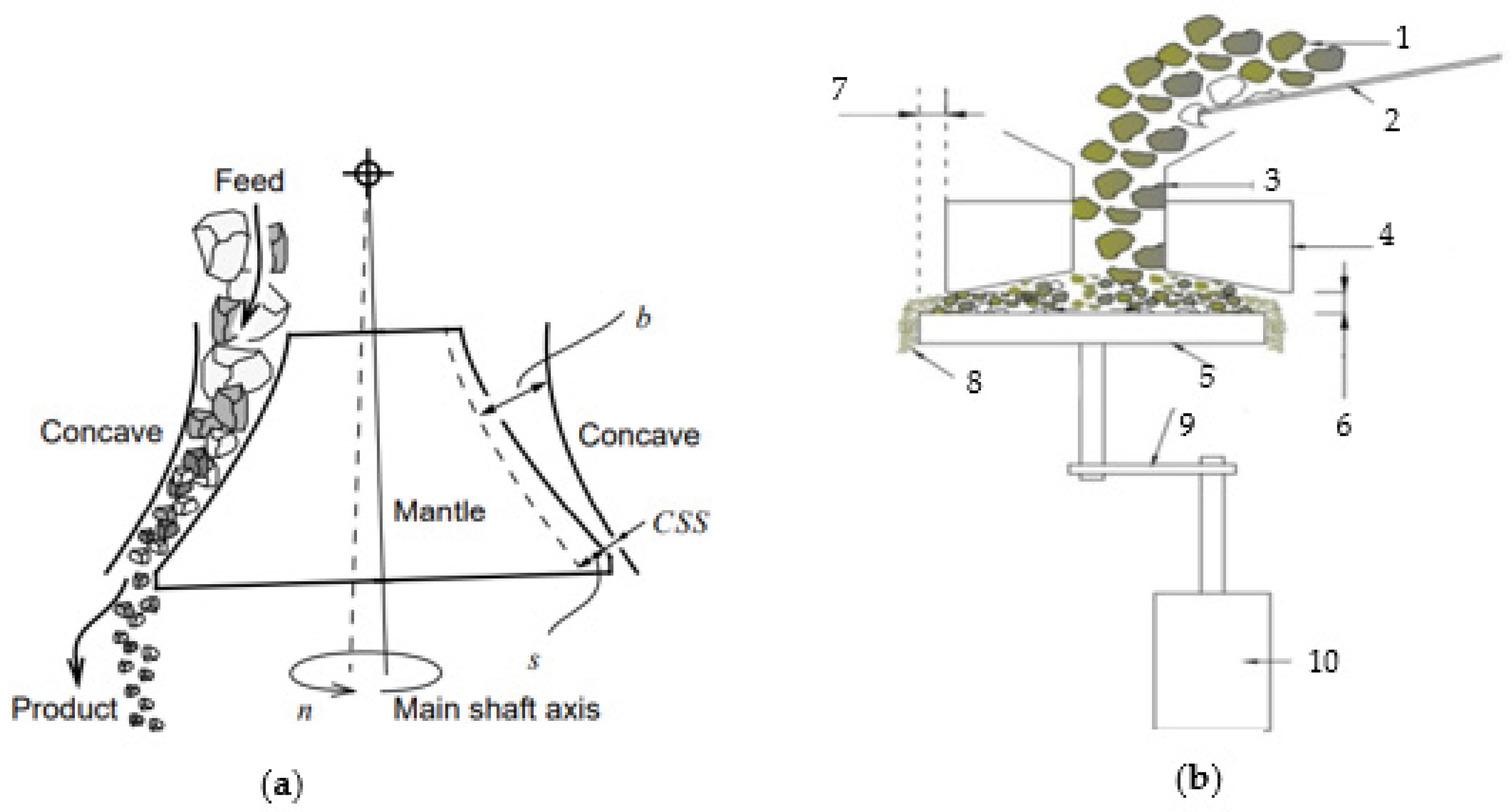

Population balance modeling helps to describe:
How fast particles break
How the size distribution changes
How much material reports to each size class
3.9 Breakage Function
Definition
The breakage function describes how a particle breaks into smaller fragments.
It provides information about:
Size distribution of progeny particles
Fraction of material entering each smaller size class after breakage
The breakage function does not describe how often particles break, but only how they break.
3.10 Selection Function
Definition
The selection function represents the probability that particles of a given size will undergo breakage.
Important points:
Larger particles generally have higher breakage probability
Smaller particles have lower breakage probability
3.11 Difference Between Breakage and Selection Functions
| Selection Function | Breakage Function |
|---|---|
| Describes frequency of breakage | Describes size distribution of fragments |
| Depends on particle size | Depends on breakage mechanism |
| Indicates which particles break | Indicates how particles break |
3.12 Population Balance in Classification Processes
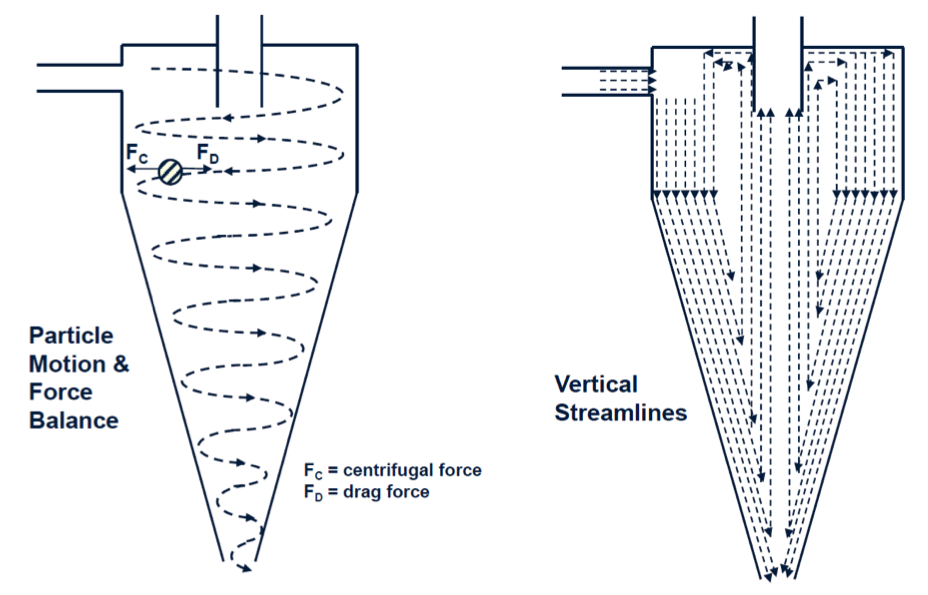
In classification processes such as screening and hydrocycloning:
Particles are separated based on size
No breakage occurs
Population balance modeling is used to:
Track distribution of particles between coarse and fine streams
Predict efficiency of separation

3.13 Role of Population Balance in Simulation
Population balance modeling is essential for mineral processing simulation because:
It tracks particle size distributions
It allows linking of unit operations
It provides a common framework for modeling different processes
Most mineral processing simulators use PBM internally to perform calculations.
3.14 Population Balance Modeling in MODSIM
In MODSIM:
Particles are divided into size classes
Population balance equations are applied
Mass balance is solved for each size class
Output PSD is calculated automatically
MODSIM primarily uses steady-state population balance modeling.
3.15 Summary
Mineral processing deals with particle populations
Population balance modeling tracks mass movement between size classes
Size classes simplify modeling of complex systems
Steady-state population balance is widely used
PBM forms the basis of mineral processing simulation
3.16 Important Examination Questions
Define particle population
Explain population balance modeling
Write the general population balance equation
Explain steady-state population balance
Define breakage and selection functions
Explain the role of PBM in simulation


Comments
Post a Comment