Gravity Separation
Explain the principles of gravity separation and its role in mineral processing. (p. 233–243)
Principles of Gravity Separation and Its Role in Mineral Processing
Gravity separation is a physical process that exploits the differences in the specific gravity (density) of minerals to achieve separation. It is one of the oldest and most effective methods of mineral concentration and is widely used in mineral processing to separate valuable minerals from gangue.
Principles of Gravity Separation
-
Density Difference
- The primary principle of gravity separation is based on the differences in specific gravity between particles.
- Heavier (denser) particles settle faster than lighter (less dense) particles when subjected to a fluid medium or gravitational force.
-
Settling Velocity
- Particles settle according to Stokes’ Law for laminar flow or Newton’s Law for turbulent flow, depending on their size and density.
- Settling velocity () is given by:
Where:
- : Particle diameter.
- : Particle density.
- : Fluid density.
- : Acceleration due to gravity.
- : Fluid viscosity.
-
Stratification
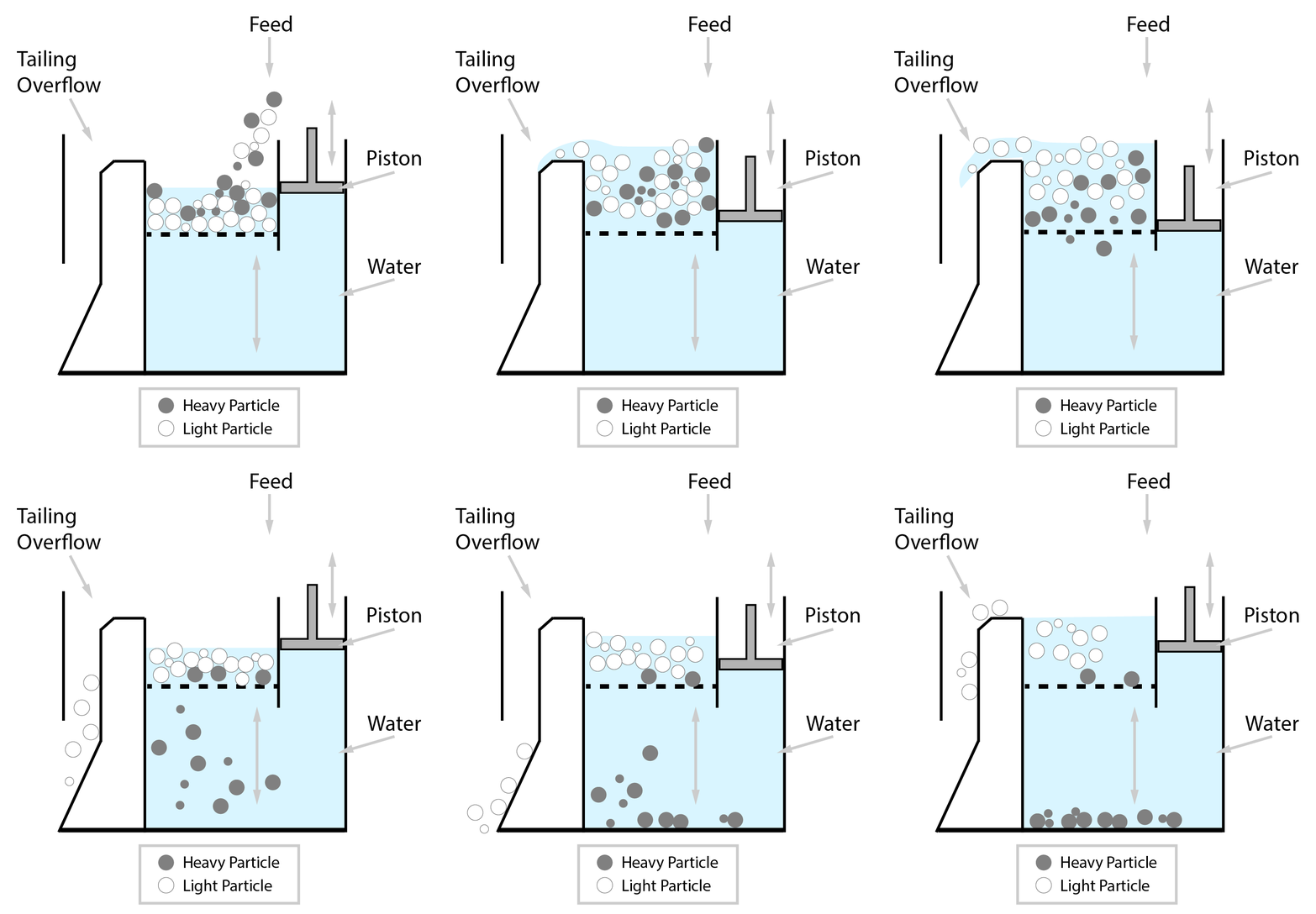
- When particles of different densities and sizes are placed in a fluid or subjected to vibration, they stratify, with heavier particles moving to the bottom and lighter particles staying on top.
-
Flowing Film Action
- In devices like shaking tables and spirals, particles are subjected to flowing water, causing lighter particles to be carried away while heavier ones remain.
-
Centrifugal Force
- In modern gravity separation equipment, centrifugal force is used to enhance the separation of fine particles.
Role of Gravity Separation in Mineral Processing
-
Concentration of Heavy Minerals
- Gravity separation is used to concentrate valuable heavy minerals, such as gold, chromite, cassiterite, and ilmenite, from gangue materials.
-
Pre-Concentration
- It is often employed in the early stages of processing to reject gangue material and reduce downstream processing costs.
-
Environmental Benefits
- As a physical process, gravity separation does not require chemicals, making it an environmentally friendly option.
-
Processing Fine and Coarse Particles
- It is effective for a wide range of particle sizes, from coarse materials in jigs and dense media separators to fine particles in spirals and shaking tables.
-
Complementary Technique
- Gravity separation is often used alongside other techniques, such as flotation or magnetic separation, for enhanced efficiency in processing complex ores.
Common Gravity Separation Equipment
-
Jigs
- Utilizes pulsating water to separate particles based on density differences.
-
Shaking Tables
- Separates particles using a combination of density differences and flowing film action on a sloped surface.
-
Spirals
- Uses centrifugal force and water flow to separate particles based on density and size.
-
Dense Media Separators (DMS)
- Separates minerals by immersing them in a dense medium (e.g., ferrosilicon slurry) where lighter particles float, and heavier particles sink.
-
Centrifugal Gravity Separators
- Modern devices like Knelson and Falcon concentrators enhance separation efficiency by applying centrifugal force.
Advantages of Gravity Separation
-
Low Operating Cost
- Requires minimal energy and no expensive reagents.
-
Environmentally Friendly
- Avoids the use of harmful chemicals.
-
Simple Operation
- Easy to operate and maintain compared to other processing methods.
-
Wide Range of Applications
- Suitable for coarse and fine particle separation.
Challenges
- Ineffective for ores with very small density differences.
- Requires controlled feed size and proper operational conditions for efficiency.
Conclusion
Gravity separation is a versatile and cost-effective method for mineral concentration. By utilizing differences in particle density, it plays a vital role in mineral processing, especially for concentrating heavy minerals and pre-concentrating ores before further processing.
Reference: R.P. King, Modeling and Simulation of Mineral Processing Systems, p. 233–243.


Comments
Post a Comment